ANCORA 5 EC
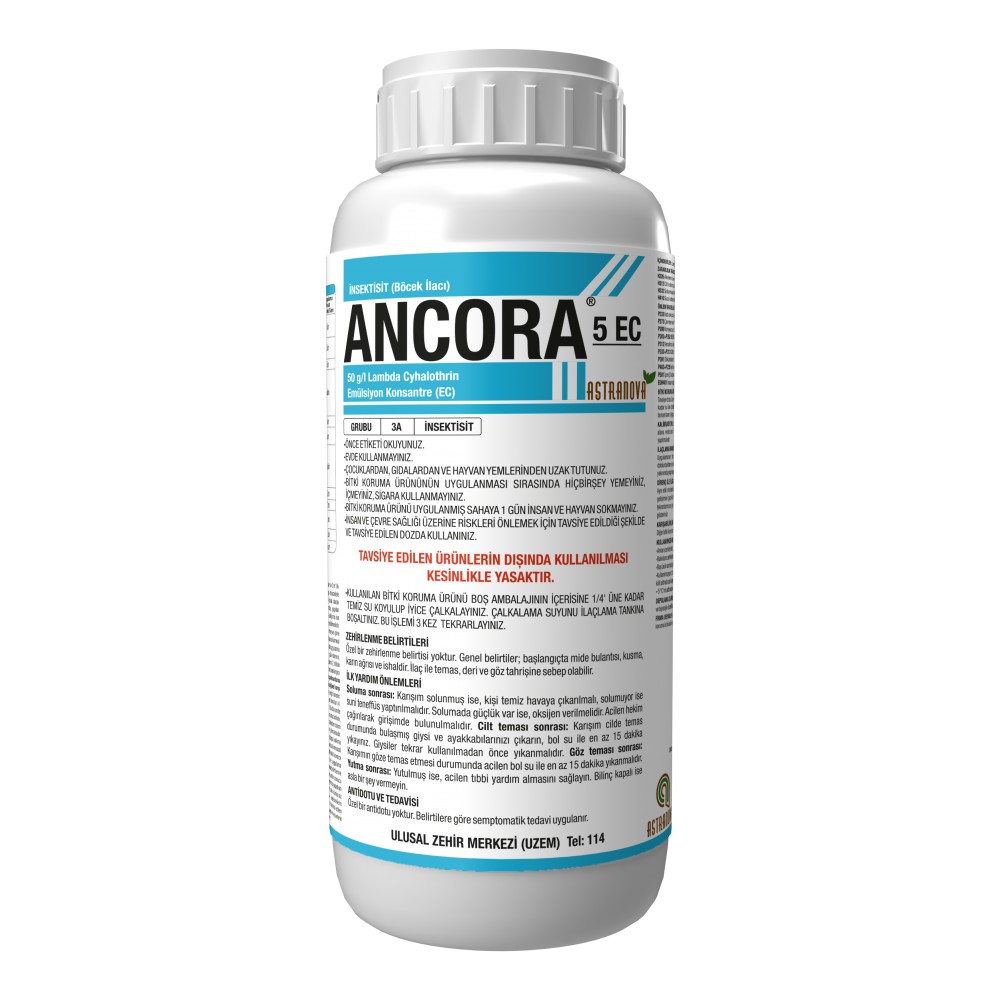
Active Incradient: 50 g/l Lambda-cyhalothrin
Formulation: Emulsion Concentrate (EC)
Packing: 100 ml, 250 ml, 500 ml, 1Lve 5L 20 L
Use plant protection products with care.
Be sure to read the label and product information before use.
Label Information Safety Data Sheet Product Brochure|
Plant name |
Name of harmful organism |
Application dose and period |
Time between final application and harvest |
|
cotton |
*Greencurrant (Helicoverpa armigera) |
150 ml/da Larva |
7 days |
|
**Two-point redfinder (Tetranychus urticae) |
At 50 ml/da, Nimf, adult |
||
|
apple |
Apple drink (Cydia pomonella) |
20 ml/100 L water, Larva |
3 days |
|
Apples were squeasy (Yponomeuta malinellus) |
10 ml/100 L water, Larva |
||
|
vineyard |
Bunch moth (Lobesia botrana) |
20 ml/100 L water, Larva |
7 days |
|
Egypt |
Corn cob (Sesamia spp.) |
At 30 ml/da, Larva (3 spraying with an interval of 15 days) |
14 days |
|
Egyptian wolf (Ostrinia nubilalis) |
At 30 ml/da, Larva (3 spraying with an interval of 15 days) |
||
|
Bozkurt (Agrotis spp.) |
At 50 ml/da, Larva |
||
|
potato |
Potato beetle (Leptinotarsa decemlineata) |
40 ml/da Larva, adult |
3 days |
|
Sugar beet |
Shield beetle (Cassida spp.) |
25 ml/da Ergin |
3 days |
|
wheat |
Perch (Euygaster spp.) |
20 ml/da 1.-3. and 4.-5.Nimf period |
14 days |
|
Beetle with cereal hose (Pachytychius hordei) |
25 ml/da, Ergin |
||
|
Crop humpback (Zabrus spp.) |
At 50 ml/da, Larva |
||
|
tomato |
Greenkurt (Helicoverpa armigera) |
At 50 ml/da, Larva |
3 days |
|
cabbage |
Cabbage leaf power (Plutella maculipennis) |
25 ml/da, Larva |
2 days |
|
Pistachios |
Pistachio psillidi (Agonoscena pistaciae) |
20 ml/100 L water, Nimf |
3 days |
|
olive |
Olive moth (Prasy oleae) |
15 ml/100 L water, Larva |
3 days |
|
hazelnut |
Hazelnut worm (Curcilio niucum) |
50 ml/da, Ergin |
7 days |
Greenworm eggs and larvae are counted by checking all plants with a row length of 3 meters randomly selected against greenfish in cotton, and the application is decided when there are an average of 2 larvae in a row length of 3 meters.
In order to determine the time to fight against two-point red spider mites in cotton, surveys are started after the plants have 4-6 leaves. If the pest is found locally only on the edge of the field and in it, only spraying specific to these parts should be done. If the pest spreads to the entire field, if the density reaches 5 in the Mediterranean region and 10 in the Aegean and Southeastern Anatolia regions per leaf, coating spraying should be done.
Apple worm: Spraying on apple worm should be directed according to the prediction and early warning system. The goal in the apple worm fight is to kill the larvae that hatch before the fruit enters the fruit by keeping the trees with medicines during the emergence of the larvae of each generation.
Apple networm: If there are 4 larva clusters that have entered the epidermis or have netted in the 100-leaf bouquet that will represent the garden, spraying is done.
Grapevine moth application times against grapevine cluster moth are determined according to the prediction-warning system. For larvicide application, the number of butterflies caught in the traps should reach its peak and begin to decrease, the effective temperature total should be 120 days-degrees in the first generation, and the twilight temperatures should be 15 ° C and above for 2 days in a row, and this situation should continue in the following days. The effective temperature total should reach 520 days-degrees in the 2nd generation and 1047 days-degrees in the 3rd generation, the grapevine phenology should be in the 1st generation flower bud, in the 2nd generation at the beginning of the sweetening period. When the first larvae hatch is seen, the application is decided. An application is made for each generation.
It is applied when the first egg is detected against corn borer and corn cobworm. After the first application, 2 more applications are made with an interval of 15 days.
When the average daily temperature against the potato beetle reaches 14-15 ° C, the pest's eggs, larvae and adolescents are searched in the hearths by entering the field diagonally. Any occurrence of any period indicates that the field was contaminated. If the application will be made against the 1st generation, it should be done when the first mature larvae (4th period) are seen in the plants. In case of application to the second generation, the completion of the egg opening should be waited. During this period, the application may not be required as the damage to be caused by the insect density can be tolerated by the plant. However, as a result of the researches, the 20% damage caused by the potato beetle on the leaves of the potato plant can be tolerated by the plant and there is no decrease in the product. This rate increases up to 40% depending on the phenological period and development of the plant.
Wheat: Against crop humpback: Surface spraying is done.
Grain pipe beetle: Spraying is done 10 days after emerging from the soil (stall period).
Sün: After the sun goes down to the fields, some counts and evaluations are made in the fields. As a result, chemical control is decided.
In tomato, by entering the field diagonally against green leaves, 50-100 plants are checked according to the size of the field, and eggs and larvae are searched in the flowers, leaves, stems, fruits and shoots of the plant. If 5 out of 100 plants are found, the application is made.
Cabbage: It is entered into the field diagonally against the cabbage leaf moth and the plant is checked every 10 steps. When the symptoms of harm are common, it is decided to spray.
It should be applied against pistachio psillidine when 20-30 nymphs per leaf are seen as a result of weekly counts on 100 compound leaves, when the majority of the eggs are opened and before the first adult parasitoid emergence and sticky layer (fumajine) on the leaf surface.
Olive moth: It is not recommended to spray the pest's flower progeny. However, when more than 10% of the leaves and new shoots are damaged at the beginning of the season in the years when the crop is scarce, a spraying is applied to the flower seed 7-10 days after the first butterflies are caught in the flower breed. Preferably, spraying should be done only against fruit seed. Spraying is done when there is a live "egg + larva" in 10% of the controlled lentil sized fruits.
Disinfestation is applied if more than 2 hazelnuts are seen on 10 January during the controls against the nut moth when the fruits are the size of the lentil.
MIXABILITY STATUS
It is recommended to do a pre-mix test before mixing with other plant protection products (insecticide, acaricide and fungicide).