DOĞER BAKIR 50 WP
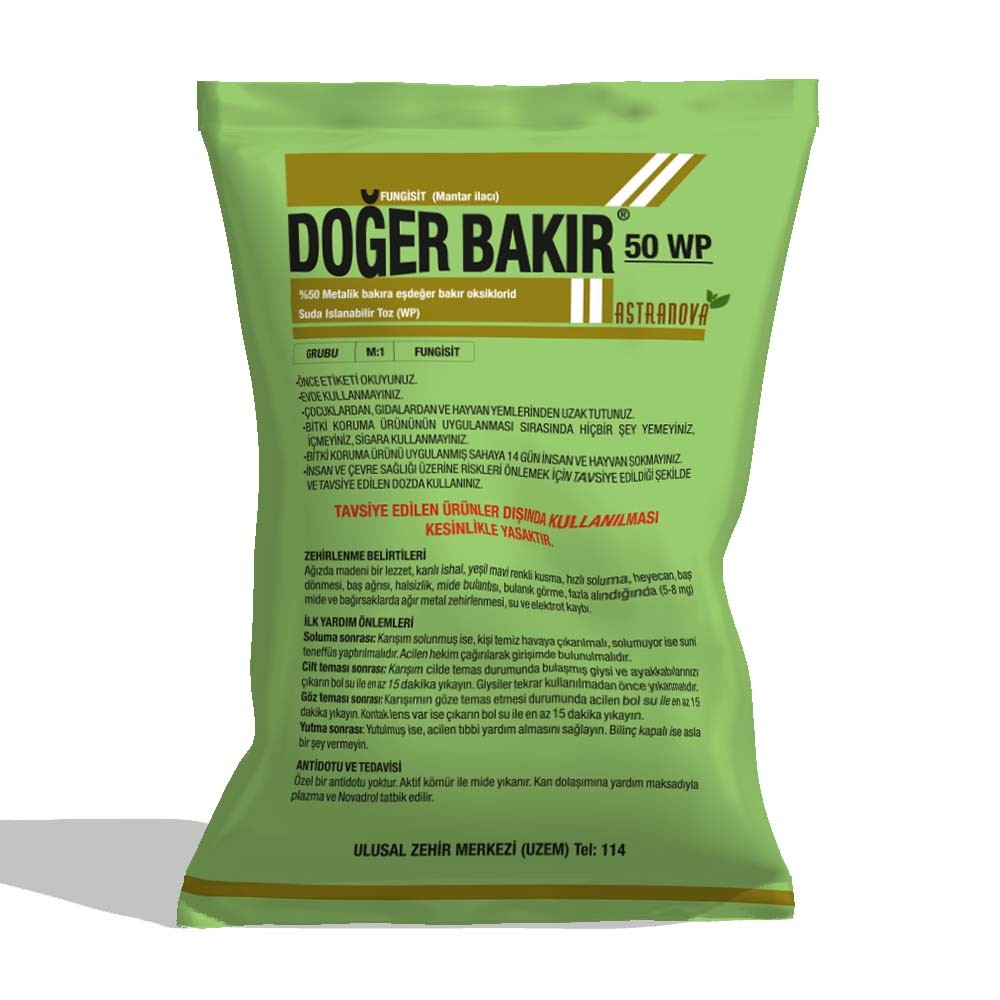
Active Ingredient: %50 Copper oxychloride equivalent to metallic copper
Formulation: Water-Wettable Powder (WP)
Packing: 800 g, 1 kg, 4 kg, 10 kg
Use plant protection products with care.
Be sure to read the label and product information before use.
Label Information Safety Data Sheet Product BrochurePLANT AND HARMFUL ORGANIZATIONS IN WHICH THE FINAL PROTECTION PRODUCT WILL BE USED
|
Plant Name |
Harmful Organism Name |
Application Dose
|
Time Between Final Application and Harvest |
|
apple |
Black stain (Venturia inaequalis) |
800 g/100 L water branch row If there is no 400 g/100 L water branch sequence |
21 days |
|
pear |
Black stain (Venturia pirina) |
800 g/100 L water branch row If there is no 400 g/100 L water branch sequence |
21 days |
|
Mammal rust (Gymnosporangium fuscum) |
400 g/100 L water |
21 days |
|
|
apricot |
Leaf-pierced in hard-core fruits (Wilsonomyces carpophilus) |
400 g/100 L water normal period 800 g/100 L water dormant period |
21 days |
|
peach |
Leaf-pierced in hard-core fruits (Wilsonomyces carpophilus) |
800 g/100 L water 1. application 400 g/100 L water 2. application |
21 days |
|
Leaf curly (Taphrina deformance) |
800 g/100 L water |
21 days |
|
|
plum |
Pocket disease (Taphrina pruni) |
800 g/100 L water |
21 days |
|
pistachio |
Karazenk (Pseudocercospora pistacina) |
500 g/100 L water |
21 days |
|
Citrus |
Tip drying (Phoma tracheiphila) |
400 g/100 L water |
21 days |
|
olive |
Ringed stain (Spilocaea oleaginum) |
400 g/100 L water |
21 days |
|
The vineyard * |
Mildew (Plasmopara viticola) |
300 g/100 L water 1.Application 500 g/100 L water 2.Application |
21 days |
|
Antracnose (Elsinoe ampelina) |
300 g/100 L water 1.Application 500 g/100 L water 2.Application |
21 days |
|
|
tomato |
Mildew** (Phytophthora infestans) |
300 g/100 L water |
14 days |
|
Bacterial speckle (Pseudomonas syringae pv.tomato) |
300 g/100 L water 1.Application 400 g/100 L water 2.Application |
14 days |
|
|
Bacterial stain (Xanthomonas vesicatoria) |
300 g/100 L water 1.Application 400 g/100 L water 2.Application |
14 days |
|
|
potato |
Mildew (Phytophtora infestans) |
300 g/100 L water |
14 days |
|
bean |
Anthracnose (Colletotrichum lindemuthianum) |
500 g/100 L water |
14 days |
|
Sleadi leaf blight (Xanthomonas axonopodis pv. phaseoli) |
300 g/100 L water |
14 days |
|
|
Halo Blight (Pseudomonas savastonia pv. phaseolica ) |
300 g/100 L water |
14 days |
|
|
Tomatoes, Eggplants, Potatoes |
Early leaf blight (Alternaria solani) |
500 g/100 L water |
14 days |
|
Peanut |
Serkospora early leaf stain (Cercospara arachidicola) |
400 g/100 L water |
14 days |
|
Vegetable Seedlings |
Collapsing and root rot (Pythium spp., Rhizoctonia spp., Fusarium spp., Alternaria spp., Sclerotinia spp., Phytophthora spp.) |
300 g/100 L water 1.Application 500 g/100 L water 2.Application (seedling application) |
14 days |
|
cucumber |
Angular leaf stain (Pseudomonas.syringae pv. lachrymans) |
300 g/100 L water |
14 days |
|
hop |
Mildew (Pseudoperonospora humuli) |
500 g/100 L water |
14 days |
|
safflower |
Leaf stain (Alternaria carthami) |
300 g/100 L water |
14 days |
*It cannot be used in vineyard areas where vineyard leaf will be harvested for consumption purposes.
HOW TO USE THE PLANT PROTECTION PRODUCT
Apple blackberry: 1. Application: When the flower eyes swell (3-5 days before the branches where there is a branch line) 2. Application: During the pink rosette bud period (when the flowers are seen separately) 3. Application: When the flower petals fall off 70-80%, 4 . and other applications should be made with 15 days intervals according to the conditions where the climatic conditions are suitable for the progression of the disease.
Pear blackberry: 1. application: When the flower eyes swell (3-5 days before the branch lines) 2. application: During the white rosette period, 3. application: When 70 - 80% of the flower petals have fallen, 4. and other applications are used for plant protection. It should be applied every 10 days, taking into account the effect of the product.
Pear mamelipa: 1. Application: Just before flower buds burst, 2. Application: Flower white rosette period, 3. Application: When 80-90% of flower petals fall off, Generally 3 applications are sufficient, in climatic conditions where spring is rainy Other applications are continued until the rains cease, taking into account the effect time of the plant protection product.
Leaf piercing (Freckle) in stone fruits (Apricot, Peach): 1st application: Immediately after leaf fall in autumn, 2nd application: Before flower buds open in spring (during pink flower bud period), In apricots, in addition, sepals and stamens in fruits 3. Application should be done while the tray is scraped to the end of the fruit.
Peach leaf curl: An application is made when the buds begin to swell.
Plum pocket disease: 1. Application: It should be done in the period when the buds swell, 2. Application: It should be done in the period when 80% of the flower petals are shed.
Blackberry in pistachio: 1. application If the fight against protective fungicides will be done, the applications must be done before the first infections, when the leaves start to open; If the fight against therapeutic fungicides is to be made, the fruits should be made in the size of the chickpea and when the leaves are fully opened. In addition, therapeutic fungicides can be applied until the first symptoms appear. 2. Application and other applications: Considering the nature of the plant protection product used, its duration of action and rainfall, it is done at intervals of 15 days.
In citrus fruits:
Green parts applications: It should be done 3 times in October, December and March.
Soil applications: In addition to the green parts spraying, soil spraying should be applied to the heavily infected trees in the garden once in October.
Ringed stain in olives
In Marmara Region: 1. application just before the autumn shoots are seen, 2. application: After the flower roots become apparent, before the flowers open, in the Aegean region: 1. application just before the spring shoots are seen, the second application after the flower soma are evident, before the flowers bloom,
In the Mediterranean region: 1st application After harvest, 2nd application just before spring shoots appear, 3rd application After the flower somacs become apparent, before the flowers bloom.
Vineyard mildew: 1st application: It should be applied when the shoots are 25-30 cm long. 2. and other applications: should be done 15 days after the first application. Taking into account the daily temperature and precipitation averages of the region, relative humidity, and meteorological factors such as dew, applications should be made when appropriate conditions for disease infection occur, and applications should be stopped when the conditions disappear.
Ligament anthracnose: Winter application: It should be applied after the ligaments are pruned, when the eyes are not yet awakened.
Summer application: When the application is made according to the phenology with the vine mildew, there is no need for a separate summer application for the vineyard anthracnose. If separate application is required, the following program is applied. 1. application: Shoots are 5-10 cm. 2. And other applications: 1. Application is made by considering the effective time of the fungicide used in the application. Applications are continued until the grains take their half size. Application is not recommended during the flowering period.
Tomato mildew: The application is started when brown spots with a diameter of 3-5 mm on the leaves of the tomato are seen on the lower face of the conidia like white ash.

OTHER COPPER 50 WP
Water-Wettable Powder (WP)
GROUP M: 1 FUNGICIDE (Fungicide)
Copper oxychloride equivalent to 50% metallic copper
Bean anthracnosis: Applications should be started when the first symptoms of the disease are seen in the region. The application continues, taking into account the severity of the disease, climatic conditions and the duration of the plant protection product. Care should be taken to treat all green parts of the plant.
Bean common leaf and halo blight: It should be applied in 2-3 applications, once a week before the disease is seen in the field or when it first appears.
Tomato, Eggplant, Potato, early blight: Application should be started as soon as the first spots appear both in the seedbed and in the field. When the climatic conditions are suitable for disease development, the application is continued at 10-day intervals depending on the disease course and climatic conditions.
Peanut cercospora early leaf spot: The application is started 4-5 weeks after sowing in places where the disease is seen every year. It can be continued until harvest.
Crash and root rot in vegetable seedlings: Applications are made by seed and soil spraying. Seed treatment: It is applied to the seed before planting. Soil spraying: It is done before planting, after planting, after the seedlings emerge on the soil surface and after the seedlings are transplanted into the greenhouse or field.
Cucumber-cornered leaf spot: It should be applied before the disease is seen in the field or when it is first seen, as a preventive application at least 3 applications with 10 days intervals.
Hop mildew: Spraying is started in the spring when the shoots are 75-100 cm on average. It is repeated with an interval of one week until the flower period. In this period, it continues at 10-day intervals until the cocoon holding period.
Safflower leaf spot: Applications are started when the first symptoms are seen in the plants.
MIXABILITY STATUS
DOĞER COPPER 50 WP is used alone. Do not mix with other plant protection products.